Kanji & Katzen Leads Boycott of D.C. N.F.L. Team Corporate Sponsors

Change.org NFL DC The firm of Kanji & Katzen PLLC has answered the call of the Seattle Human Rights Commission and voted to boycott the D.C. N.F.L. team’s key corporate sponsors until the team’s name changes.  This includes ceasing use of FedEx in the firm’s two offices, and closing the firm’s accounts at Bank of America.

Many people remain unaware that at one time in American history Native Americans were hunted, killed, and redeemed for bounties.  Native scalps, skin, and other body parts of women, children, and men served as proof of the bounty kill; hence the name “r*dskins.”  [Read more…]

Seattle Adopts Indigenous Peoples’ Day

Indigenous Peoples’ Day

Renée Roman Nose, Mayor Murray, Zona Evon, Ethel Branch Photo Credit: Chris Stearns

On Monday, October 13, 2014, the City of Seattle celebrated Indigenous Peoples’ Day for the first time, just one week after the Seattle City Council passed Resolution No. 31538 declaring the observance. On the day of the celebration, Mayor Murray signed the Resolution in a room packed with supporters. This historical moment marks Seattle’s commitment to a unique and human rights-driven approach to engaging with local Native Nations and with the significant urban Indian population that resides within Seattle.

Resolution No. 31538 recognizes that the city is built on Indigenous lands, acknowledges the contributions of the Indigenous Peoples of this region, and seeks to close the equity gap for Indigenous Peoples of Seattle. It establishes as official policy that city staff will participate in the annual Indigenous Peoples’ Day celebrations; encourages businesses, organizations, and public entities in the city to recognize the Day; and strongly encourages Seattle Public Schools to include the teaching of Indigenous Peoples’ history in its curriculum. Seattle Public Schools passed its own resolution on October 1st recognizing Indigenous Peoples’ Day and strongly encouraging district staff to teach the culture, history, and governments of the Indigenous Peoples of the region.

Resolution No. 31538 builds on the efforts of the 1977 delegation of Indigenous Peoples that proposed observance of the day to the United Nations and of the Affiliated Tribes of Northwest Indians, which passed a 2011 resolution supporting the observance of Indigenous Peoples’ Day. The Resolution was proposed by local Native community members and supported by the Seattle Human Rights Commission, which passed its own resolution requesting that the city and Seattle Public Schools recognize the second Monday of October as Indigenous Peoples’ Day.

Mayoral Signing

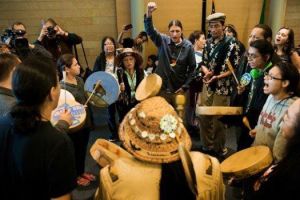
Native community members, including Matt Remle (with fist raised) and Nahaan (right of Matt), commemorating the day. Photo Credit: Chris Stearns

Successful passage of the Resolution was the result of the stalwart leadership of Matt Remle (a member of the Hunkpapa Lakota (Standing Rock Sioux Tribe) and one of the community members who presented the Indigenous Peoples’ Day proposal to the Human Rights Commission) and Millie Kennedy (a Tsimshian (Raven Clan) attorney at the Northwest Justice Project who helped organize events leading up to and memorializing the Day), the Seattle Human Rights Commission (including Co-Chair Ethel Branch, a member of the Navajo Nation and an Associate at Kanji & Katzen, PLLC), the City Council (including Resolution Co-Sponsors Bruce Harrell and Kshama Sawant), and Mayor Murray (including his Tribal Liaison, Nicole Willis, a member of the Confederated Tribes of the Umatilla Indian Reservation).

The effort was also buoyed by the support of local tribal leaders, including Fawn Sharp (President of Quinault Indian Nation and President of the Affiliated Tribes of Northwest Indians), Leonard Forsman (Chairman of Suquamish Indian Tribe), Ron Allen (Chairman of the Jamestown S’Klallam Tribe), David Bean (Councilmember of Puyallup Tribe of Indians), and Theresa Sheldon (Board Member of Tulalip Tribes and co-author on the ATNI resolution calling for recognition of Indigenous Peoples’ Day).

The city’s action is one positive step forward on the path to advancing indigenous human rights in the Pacific Northwest, and it enhances the city’s status as a human rights city. Indigenous Peoples elsewhere may soon join in this celebration as national momentum builds to observe the second Monday in October in similar fashion. Minneapolis officially recognized the day as Indigenous Peoples’ Day in April, and on October 13, 2014, the City of Bellingham recognized the day as Coast Salish Day. Berkeley and other California cities made the name change long ago, and several states do not observe Columbus Day, including Alaska, Hawaii, Oregon, and Washington. South Dakota observes Native Americans’ Day.

For coverage of this important change in the Seattle Times, please follow these links:
Mayoral Signing: http://seattletimes.com/html/localnews/2024772785_indigenoussigningxml.html
City Council Vote: http://seattletimes.com/html/localnews/2024715781_indigenousdayxml.html
Pre-Vote: http://seattletimes.com/html/localnews/2024708926_columbusday2xml.html

Supreme Court Denies Review in Katie John case!

On March 31, 2014 the Supreme Court denied review in the Alaska subsistence litigation known as the Katie John case.  The State of Alaska’s lawsuit was filed in 2005.  It asked the Court to overturn federal rules promulgated in 1999 that include waters subject to the federal reserved water rights doctrine in the definition of public lands in Title VIII of the  Alaska National Interest Lands Conservation Act (ANILCA).  The federal rules provide a subsistence priority on those waters during times of shortage for rural Alaskans. The case is the third in a series that was commenced in 1985 to obtain the subsistence protections promised in ANILCA.

Kanji & Katzen represented the Alaska Federation of Natives (AFN) in the litigation as an intervenor in support of the 1999 federal rules.  AFN is the largest statewide Native organization in Alaska. Its membership includes 178 villages (both federally-recognized tribes and village corporations), 13 regional Native corporations and 12 regional nonprofit and tribal consortiums that contract and run federal and state programs. The mission of AFN is to enhance and promote the cultural, economic and political voice of the entire Alaska Native community.

The State of Alaska was joined by thirteen states and the Pacific Legal Foundation in an effort to obtain Supreme Court review of a successful Ninth Circuit decision.   A link to AFN’s press release on the matter is below.

http://www.nativefederation.org/2014/03/31/afn-applauds-supreme-court-decision-on-katie-john-case/

David Giampetroni Is Now A Member of Kanji & Katzen

Kanji & Katzen is pleased to announce that David Giampetroni is now a member of the firm.

David started with the firm as an associate in 2006 after a clerkship with the Honorable David F. Hamilton of the United States District Court for the Southern District of Indiana, now with the United States Court of Appeals for the Seventh Circuit.  Prior to his clerkship David graduated from Indiana University School of Law – Bloomington, magna cum laude, Order of the Coif, where he served as Managing Editor of the Indiana Law Journal.  Since joining Kanji & Katzen, David has represented tribes and tribal members in federal, state, tribal and administrative courts on numerous Indian law issues, including treaty rights, land claims, reservation issues,  gaming compact disputes, tribal jurisdiction, tribal employment and tribal membership and enrollment.

Washington Tribes Win Treaty-Based Injunction to Protect Fish Habitat

On March 29, 2013, a coalition of Washington tribes, with the firm serving as lead counsel, obtained a precedent-setting injunction against the State of Washington, requiring it to correct culverts under state highways that block fish passage. The culverts cut off more than 1,000 miles of salmon habitat and undermine tribal treaty fisheries.  The court ruled that the treaties, which reserved to the tribes “the right of taking fish, at usual and accustomed grounds and stations,” necessarily implied protection of the habitat on which treaty fisheries depend.  The court gave the State seventeen years to correct 1,600 barriers, and required coordination with affected tribes.  The decision puts teeth into a 2007 summary judgment order, which declared that the culverts violate treaties made with the tribes in the 1850’s.  The culverts decision is the culmination of a decades-long legal effort by Washington tribes, who first presented their claims for treaty-based habitat protection as part of the 1974 “Boldt decision,” which recognized tribal treaty rights to half the salmon catch and freedom from most state regulation.

For a copy of the Injunction, click here.  For a copy of the Memorandum and Decision, click here.  And for a copy of the 2007 Summary Judgment decision, click here.